
A Bird's-Eye View
Looking at battles and ballrooms from above in Sergei Bondarchuk's War and Peace (1967)

I was on a plane somewhere over Mexico, gripping the armrest and listening with unusual concentration to Parminder Nagra and Keira Knightley, running around in cleats, in a film I have seen countless times. You know the one with all the fancy football footwork and that Irish lad, who would later play King Henry VIII in The Tudors, looking super fine in a jersey? I was laser-focused as there had been a lot of turbulence the previous twenty minutes or so and I was panicking without making too much of a show of it. The cabin lights shuddered as our seats convulsed underneath us. The stranger beside me had been muttering a prayer under her breath to the Lord Almighty and, so, I would rate the overall situation as 6/10 in intensity. Then….whoosh!, she grabbed onto my arm and yelped. A pure drop for three seconds, maybe less, but you know how these things go when your life is precariously hanging 32,000 feet over land your feet should be on.
I didn’t want to freak her, the stranger sitting next to me, out by also freaking out so when things started calming down I tried taking a sip of water, from those little thimbles airlines call cups, like nothing happened. But the water was sloshing around as my steady hand had finally faltered and betrayed my calm exterior. Whoa there! Calm yourself. I looked out the window onto an expansive view of Guadalajara; we were ready to land, but it’s when the engines turn off and we’re coasting that I find life very peaceful. It’s at this point in a flight where my mind shuts down and goes absolutely numb. Forget everything; you’re just a body whizzing through the atmosphere and nothing more. This is where I always want to be, in the middle between the Icarian turbulence up above and the land-dwelling turbulence down below. The sweet spot with a bird’s-eye view.
Bird’s-eye views will lift you above the roads and roofs and baseball fields and the small bright cars moving along their appointed lines, but not so high that the world is an abstraction you don’t care all that much about. It’s a middle distance, at the perfect height where things just begin to show their meaningful texture and patterns; where you have the illusion of sufficient understanding, but enough distance to avoid the vulgar business of getting too close and burning your fingers.
It's a great life skill but also one helluva cinematic trick. And it's here that I want to write about Sergei Bondarchuk’s 1967 adaptation of Leo Tolstoy’s War and Peace. Bondarchuk gives us what I consider one of the greatest films of ALL TIME and he made use of the bird’s-eye camera view to great effect.
The Soviet government authorized the use of thousands of Red Army soldiers for Bondarchuk’s famous recreation of the Battle of Borodino1. In this scene, the camera pans over the dead and wounded as a cannon ball firing across the battlefield. Do we know whether these are Russian or French soldiers? Not really. All we see are bodies and smoke billowing about; war, a great equalizer of men.
What Bondarchuk gives us here is the beautiful cruelty of scale. He draws us close enough to know Natasha, Pierre Bezukhov, Andrei Bolkonsky, all these complex characters. Andrei Bolkonsky’s chilling monologue the night before the battle is an intimate look at his feelings:
“My country. The fall of Moscow. Tomorrow, I shall be killed. Then why this trial, when tomorrow I shall cease to exist? I won’t exist. So who is this trial for? New conditions of life will begin about which I will know nothing. I will cease to be. I will no longer exist…..I will no longer exist…..”2
And then, he pulls the camera back until the named characters become only part of a wider human wreckage. War happens to men with no dialogue or close-ups. Look there, will you? Do pay attention or the war will get you too.
In another great scene earlier in the film, Natasha Rostova attends her first ball. She is all nerves, suffering a private humiliation of wanting to be chosen.
“Is it possible that no one will come up to me? Is it possible that no one will notice me? […] They must know how I long to dance, how splendidly I can dance, and how they’ll enjoy dancing with me.”3
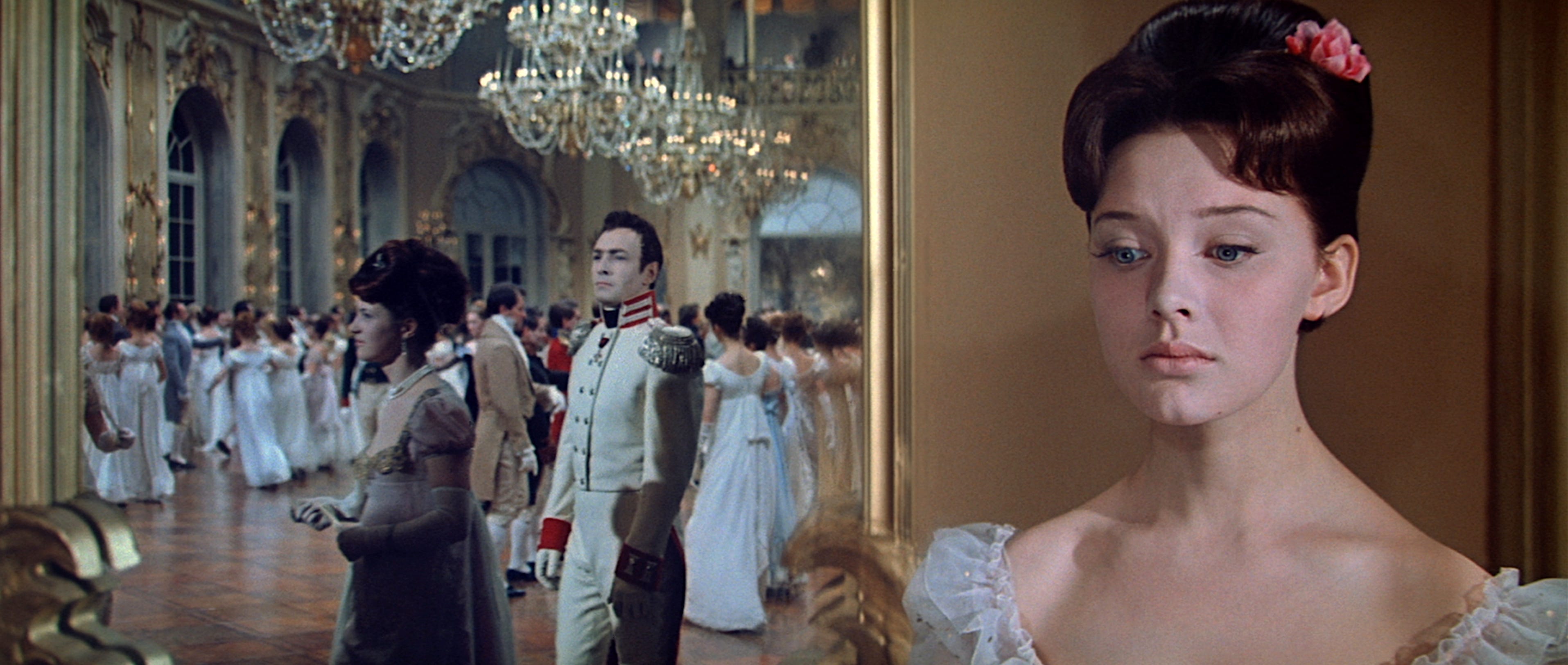
In a moment of just glorious acting by Ludmila Savelyeva, who played Natasha, we see a yearning there in her eyes, bright and desperate and indecently tearful. Then Prince Bolkonsky walks across the ballroom to ask her for her first dance. Hurray! We see her wisp through the ballroom crowd, light and quick on her feet. And then, just when we are tempted to stay with her in this grand miracle of being chosen, Bondarchuk pulls the camera back. Natasha’s individual feeling becomes part of a wider pattern of people being chosen, and choosing and simply enjoying themselves.
See around minute 10:35 for the bird’s-eye view you saw in the Battle of Borodino scene earlier.
It would be easy to look at these two scenes (the Battle of Borodino and the ballroom scenes) and see the grand division promised by the title: War on one side, Peace on the other. ooooohhh ahhhhhh Here is the battlefield, seen from above, with its dead and maimed soldiers. And there, in opposition, is the ballroom: peeking coquettishly through fans, men and women turning in their finest clothes….no one dying real deaths.
BUT!!!!! But….
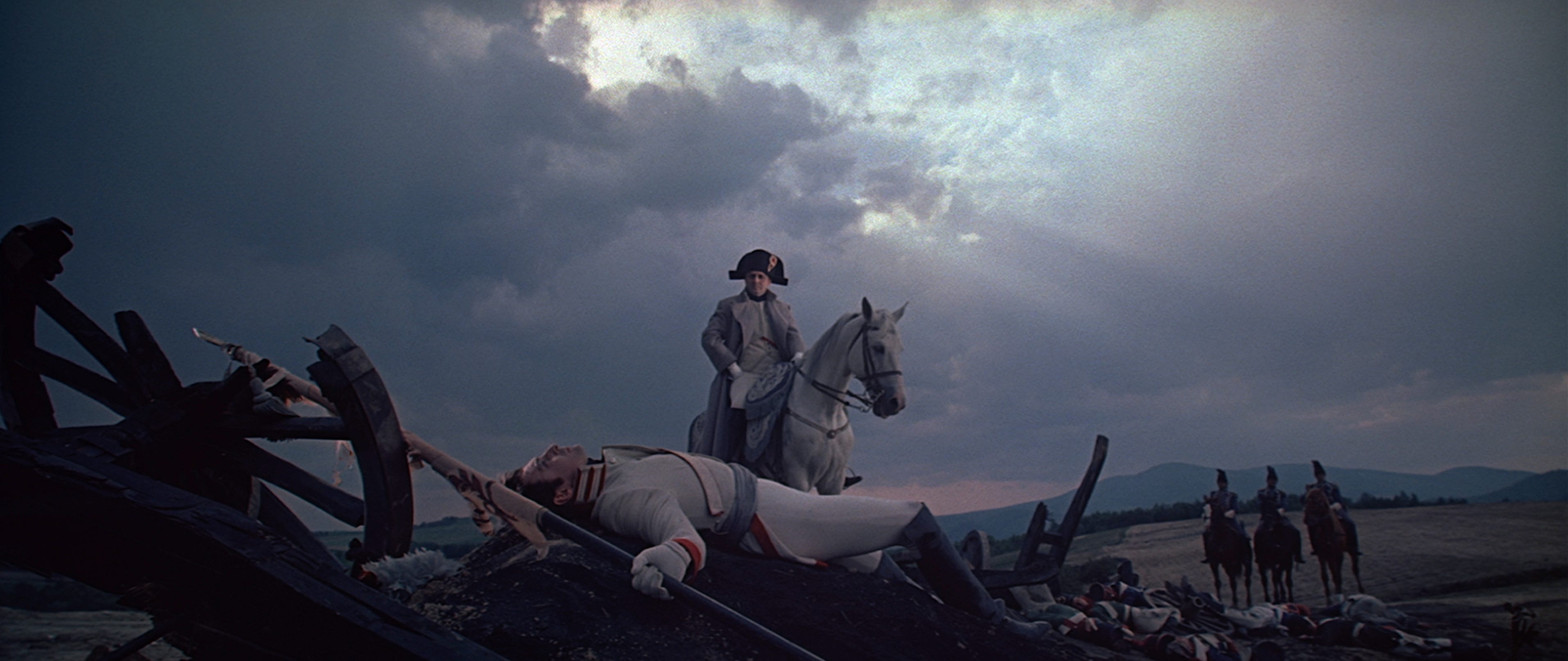
Bondarchuk keeps returning to Tolstoy’s great, unsettling proposition: war and peace are not complete opposites. gasp. To see this fully, we have to leave the bird’s-eye view for a moment and look from the ground up. At the Battle of Austerlitz, Bolkonsky is wounded and falls.
For much of the battle, the camera has been constantly in motion: men running, shouting, riding their horses, dying,. Then Andrei is struck down, and for one of the first times, we are no longer looking down. We are flat on the earth, looking up, robbed, even since some nameless soldier has already helped himself to Andrei’s necklace. And then, in my favorite scene of the whole film, Andrei looks up.
“How quiet, peaceful. How majestic. How different from all the running, shouting and fighting. How is it that I have never noticed that glorious sky before? How happy I am that I have seen it at last! Yes, all is vanity. All is false except for that endless sky. Nothing exists but the sky.”4
Then a cut to complete darkness.
“And even the sky does not exist. There is nothing but quiet and peace. Thank God for that.”
Then a cut to Napoleon looking down at Bolkonsky who says
“A glorious death.”5
After all the running, shouting, and fighting (this, where glory and rank and Napoleon do matter) Andrei looks up and finds peace in the one place it should not exist: the battlefield. War contains peace when the self is stripped of illusion and there is no need to think about rank and glory. As Part I ends and the camera pulls back over the battlefield, Andrei’s private revelation becomes part of Tolstoy’s larger pattern: human beings swallowed whole by these artificial systems, briefly illuminated by Bondarchuk’s bird’s-eye view.
For more interesting behind-the-scene details about the film, see: https://www.criterion.com/current/posts/6463-war-and-peace-saint-petersburg-fiddles-moscow-burns?srsltid=AfmBOorjqoQ0MiBK2HM1sNQawFBsl3EcHfzwegw--HMzlWEts_Ue_RXo
Ella Taylor, “War and Peace: Saint Petersburg Fiddles, Moscow Burns,” The Criterion Collection; Cornell Cinema, “War and Peace: Chapter III, The Year 1812.”
Quotes from the movie come from the English subtitle translation of the film on Amazon Prime Video.
Bondarchuk, Sergei, director. War and Peace. Mosfilm, 1966–67. Amazon Prime Video, English subtitles, accessed 9 Mar 2026.
See footnote 2
See footnote 2
English translations of this line vary meaningfully. The Amazon Prime Video subtitles give Napoleon’s phrase as “a glorious death,” while the Maude translation of Tolstoy’s novel renders it as “a fine death” which are two very different things.
I was fortunate enough to see Bondarchuk’s “War and Peace” on the big screen at an early 20th century movie palace in downtown Hamilton, Ontario back in 1968. The film was shown in two halves, each half being granted its own two-week run. I was in high school at the time, where my lifelong interest in the Napoleonic Wars had first been sparked by the special edition LIFE magazine issue of June 18, 1965—which I still have—commemorating the 150th anniversary of the Battle of Waterloo. It was a wonderful experience to see such a memorable film as “War and Peace” on the silver screen in a large cinema equipped with a theatre sound system. The battle scenes—especially the spectacular helicopter shots—were totally overwhelming and like nothing that I’ve seen in a movie before or since, not even Bondarchuk’s 1970 film of “Waterloo”.
It was precisely because the Soviet actors were pretty well unknown in the west that their performances were so believable. I found Vyacheslav Tikhonov especially effective as Prince Bolkonsky, and I appreciated the effort made to find actors to portray Czar Alexander, Marshal Kutusov, and Prince Bagration who actually resembled their historical counterparts.
In terms of costumes, uniforms, and hair styles, the film makers did an excellent job of making their handiwork appear true to the period, more so than in any other Napoleonic movie that I've seen (except perhaps for "Master and Commander" if you overlook Russell Crowe's attempt at a naval bicorne).
My own favourite scene is the lengthy sequence (which you include above) beginning with Natasha preparing for her first grand Moscow ball, her agonizing period standing as a mere spectator, culminating in Prince Andrei finally asking her to dance with him. I’ve read “War and Peace” three times over the years, including Tolstoy’s original version that ends with Andrei surviving his Borodino wound, and giving his blessing to Natasha and Pierre’s wedding, recognizing that he and Natasha were never well-matched to begin with.
If anyone is interested, Bondarchuk’s “War and Peace” is available for free viewing on YouTube, in a four-part, high resolution, digitally restored print. It's in the original Russian with English subtitles.
I love history most when it refuses to let us hover safely above the map. The bird’s-eye view helps me understand why nations move, but the human view keeps me from forgetting who pays for those decisions.