
Awakening the Beast
Chapter 3 of a Historical Fiction of The Peasants' Revolt of 1381

Chapter 1 —>

Chapter 2 —>

Chapter 3
Alfred stepped between them before Walter’s knife could rise another inch and laid one hard hand upon the man’s shoulder. “Take care, Walter. That is no rat.” His voice was steely low, ‘’tis but a girl with no sense to her.”
From the wreckage of the loft, amid broken timber, tumbling hay, and thick dust, Eleanor slowly raised her head from under the rotten horse blanket, like a crooked and foul crown upon her brow. Blood dripped down her arm from the cuts created as she tried hanging onto the timber, and dark bruises were already blooming beneath her sleeve.
“Eleanor?”
“Yes, Father” she squeaked out.
A murmur passed through the barn from the men while Alfred closed his eyes briefly and put his hand up to massage his temples. Of all his children, it would be Eleanor. He caught her by the arm and pulled her free of the ruined boards. “Come child, are you hurt?” Eleanor stood up straight and brushed off the dust from her frayed dress and seeing that she was not so seriously harmed continued.
“We are finished here,” Alfred told the others. “Go home by separate roads. I shall see the girl safely returned, and Agnes shall be made ready when the time comes.”
Oswin moved within the little space that remained between the door and Alfred, broad as an oak door, his face darkened by dirt that no river in England could ever wholly remove. He carried no other tools that night, but his hands were weapons enough, scarred by sparks that flew from the iron and hardened by years at the anvil. “She heard everything, Alfred, we can’t just let her go.” Oswin said this softly but with a firmness as he looked on around him at the other men who, in their turn, looked upon Eleanor with varying measures of pity, suspicion, and fear.
Alfred drew Eleanor closer, “What wouldst thou have me do, Oswin? She is my daughter. A good girl as I said with no sense and no harm. She will say nothing, I will make sure of it. She does what her mother and I tell her.”
“Let her keep a close ward upon her tongue,” Oswin said, “lest it wander.”
Simon shifted upon the broken chest, his old knees protesting. “Leave the girl her tongue, Oswin. Folk with no sense take more hurt than the rest of us,” he side-eyed Martin and then continued, “and the world will punish her soon enough without thy axe lending a hand.”
Alfred turned slowly toward the blacksmith and the old man Simon. “Speak no more of bridling what is mine to answer for. She is my daughter, not some stray cur to be beaten quiet at thy pleasure.”
Hugh Talmadge spoke up and his jaw tightened. “And when her foolishness puts a rope about all our necks, what then?”
“Then the blame shall be mine, and I shall bear it.” Alfred stepped closer. “But mark me well: no man beneath God shall lay hand, axe, or threat upon her while yet I stand.”
The fool and jester, Martin Fletcher, chimed in with a quip, “Aye, Alfred, sleep standing and pray the same, lest one of us see thee crouch and think thee finally surrendered,” he cackled through his rotten teeth. Alfred turned and crossed the barn in two large strides and with a smile still upon Martin’s face seized him by the throat with one hand and drove him backward against the wall. The boards boomed beneath the blow, and grey dust sifted from the rafters.
“I…I meant no…Alfred, it was only…only a jest…” The words broke apart in Martin’s throat. What little breath remained came out in thin, wet gasps. “On..on my life, I meant…no harm…1”
Alfred leaned close and tightened his grip. “I have had enough of your jests,” Alfred said, drawing so near that Martin could feel each word against his face. “Mock me or my daughter once more, and I shall break your neck, feed your eyes to the crows, and leave your frail bones for the wolves to gnaw on. After the beasts have eaten thee and shat thee into the mud, God above shall not claim you. Even the earth below shall know your flesh for filth and refuse to swallow it. Do you want that, Martin,” Alfred’s nostrils flared and his grip tightened more still, “huh? to be a shat that no one wants? Give me but one more jest, and we shall learn.”
“N-nay, Alfred,” Martin choked, clawing at the hand upon his throat. “That, that sounds most unpleasant.”
Thomas Payne approached without haste and laid a steady hand upon Alfred’s forearm. “Enough, Alfred. Loose him.” His voice was soft, but it carried more command than Oswin’s threats, Martin’s jests, or Walter’s naked steel. “We trust thee to govern thine own house, and the girl with it. Right men?”
“Aye, Thomas” they all acquiesced through small affirmations and nods. Simon crouched silently on the chest.
Alfred held Martin a moment longer before Thomas’s gaze settled upon him and he finally let go. Martin choked and coughed while Thomas turned his attention to the seven other men, and the eighth conspirator. “Our fear hath fixed itself upon what the girl might do,” Thomas continued, “whilst we neglect what dawn shall certainly do to us here. A careless tongue may betray us, but it is the rising sun that surely will.”
He looked around at the gathered men. “Go now, each by a different road. Let no two shadows leave this barn together. We came here to weigh the duke’s weakness, not to hang ourselves from his gallows. Go, all of you!”
As each of the men left the barn, Thomas patted Alfred’s back before he flung his cloak over his head and left father and daughter together and alone. After a moment’s silence, the first pale shaft of dawn slipped through the rent in the roof and fell across the barn floor. Within it, dust turned and climbed in a slow, dizzying column, circling through the light. Eleanor pressed close beside Alfred, bruised and tearful, while the wide, empty barn seemed to withdraw around them and leave them alone with the coming day.
“Father, I am sorry. Truly.”
Alfred didn’t answer and got up to leave the barn. Eleanor followed several paces behind him, stumbling through the wet grass outside with tears burning her cheeks.. He strode away from the barn, his cloak snapping at his heels, one hand turning the little knife from his belt over and over between his fingers.
“Father, please.”
Alfred didn’t even turn his head back toward Eleanor, “I have no words for a foolish girl.”
“I am not foolish.”
Alfred stopped and turned so sharply that Eleanor nearly walked into him. His brow was knotted, and the fury in his face frightened her.
“Not foolish?” he said. “You left your bed in the black of night, crossed half the land alone, climbed into a loft rotten enough to cast you through its floor, and lay silent above armed and desperate and hungry men speaking of desperate and hungry plans. Tell me, Eleanor, what name would you give such wisdom?”
She wiped her tears with the back of her hand. “I went only to look upon the stars.” Then, as she had done when she was very small, she reached for her father’s hand.
Alfred struck it aside. “The stars?” he said, confused.
Eleanor drew the rejected hand against her breast and cradled it in the other. When she answered, her voice came rough and broken. “I did not know the men would come.”
“The night is full of things you do not know. Name it a dangerous thing and leave it alone.”
Alfred stepped nearer and pointed the knife toward the distant barn. “Walter nearly opened you from breast to belly. One startled hand, one foolish movement from a foolish girl, and I would be carrying what remained of you home beneath my cloak. The stench of fool rising from your corpse.” His voice broke upon the last words and he looked away before she could answer.
Eleanor had expected anger, but not grief cocooned inside of it ready to grow and fly out. “I am sorry,” she whispered again.
Alfred shut the knife and thrust it back into his belt. “Sorry is a poor shield, Eleanor, it will eat your insides, spit you out for the crows to take. Learn to obey first and leave sorry for the wind, it won’t do you any good here.” He resumed walking.
Eleanor hurried after him, already regretting the apology. She was sorry and sorry for all the sorry’s, certainly, but every admission of guilt gave her father fresh stones to throw so she abandoned remorse and reached instead for a plea. “Father, do not let them involve Mother in their schemes. They’ll use her and catch her… they’ll hang her if she is caught stealing in Beauchamp’s chamber. Is it all worth it? For what?”
“Schemes, she calls them. Is it worth it? she asks, as though hunger were not worth the fight.” He dragged a hand across his forehead. “Schemes are for men with full bellies. This hunger…it is in all of us now, Eleanor. In me, in thee, in thy mother, in thy brothers and sisters. It sits at our table and crawls into bed beside us after our prayers when the fire dies and all is quiet.” His voice fell lower, “this hunger was in my father before me, and in his father before him. Hunger is handed down like an old tale, it’s in our words, but not in our blood.”
Eleanor was not listening. “Keep her safe, father, find another way, please, don’t tell her about the sch ... the plan.” Eleanor tapped into that hunger driven by an all consuming love for another.
“You would keep your mother ignorant of the danger then? so that she cannot choose it? And you call that protection? I would keep every soul beneath our roof alive, but if I hide the truth from your mother because I fear what she may do with it, then I have not guarded her life but have taken her will, which is always more important Eleanor. Always.” Alfred stooped and plucked a withered stalk from beneath the hedge. He crushed the hollow grain between his fingers, and when he opened his hand the chaff did not fall. It rose slowly from his palm, turning in the pale light like golden ash until it fell again.
“Father, what is will but that of God’s?”
Alfred finally took Eleanor’s hand, “If God gives us hunger, let us bear it without shame and if there be fear, let us master it. But He gave us hands also, Eleanor, and a tongue with which to cry against wickedness.”
Then he released her, and the warmth of his hand was gone. “Go now to your mother, and quick. She will soon be waking, and the day has burdens enough for her without the loss of your help. I must away to the fields before the sun climbs higher.” He turned toward the whitening furrows, where the long shadows of the hedges still lay upon the earth and left Eleanor alone.
She had gone scarcely a hundred paces along the lonely road toward the village when the stillness broke beneath the pounding of hooves. The sound came first through the ground. Eleanor felt it in the soles of her feet, a deep and hurried beating that awakened the monster in the earth. The hedgerows stirred and those shiny blackbirds scattered from the thorn, where a ride broke through at a gallop.
Eleanor sprang aside.
The horse passed so near that its shoulder struck the edge of her cloak and spun her against the hedge. Thorns caught at her hair. The animal reared, iron shoes flashing pale in the dawn, while its rider hauled savagely upon the reins.
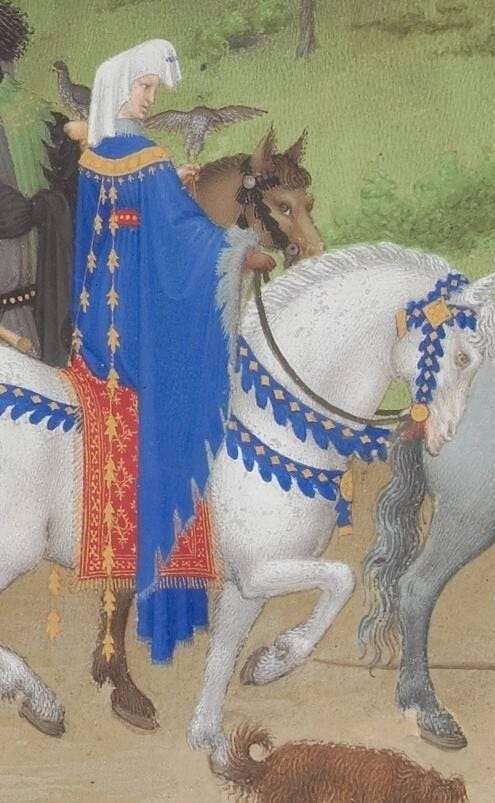
“Hold, damn you!” The horse came down hard enough to shake the road. Its rider was young, though dressed in the green and silver of the York household. A short hunting sword hung at his hip, and a hooded hawk clung to his gloved fist, its little bells trembling. His cloak was fine, his boots unmarked by hard labor, and upon his breast gleamed the white hart of the duke’s house. Eleanor knew him before he spoke as the Lord Osric, the duke’s eldest son she had seen come in with the duke, his knights, and Beauchamp just yesterday. He stared down at her, more affronted than alarmed. “Have you no love of life, girl?”
Eleanor pulled herself free of the thorns. “Enough to leap from beneath your horse, my lord.”
“You stood in the middle of the road.”
“I was walking upon it.”
His brows rose. For a moment she thought he might strike her. Instead, something near amusement troubled the corner of his mouth and he let out a chuckle. “You speak boldly for one covered in straw.” Only then did Eleanor remember the hay caught in her hair and clinging to the wool of her dress. She plucked one stalk from her sleeve.
“And you ride boldly for one who cannot stop his own horse.”
A horn sounded in the distance; Osric glanced toward it. Eleanor saw then that he had outridden the company. No knight waited at his shoulder and he was alone upon the road.
“What were you doing out here before sunrise?” he asked.
“I went to look upon the stars.”
He studied her more closely. “You have a strange tongue.”
“I am fortunate still to possess it, my lord. But I must away to my mother.” Eleanor bowed, though not so deeply as rank required, and continued toward the village.
“Your mother is that witch-wife they call Agnes?”
The words stopped her. Osric remained astride his horse, the hawk upon his fist and the pale mist gathering around him, so that for a moment horse, bird, and rider seemed not three creatures, but a single beast out of some old tale. For one strange breath, Eleanor thought that, were he to call her into his dreams, she might follow him there. And through her thoughts there shimmered the burden of an old minstrel’s lay, such as wandering harpers sang beside winter hearths when the roads were trodden smooth and buried beneath snow:
🎶 “Dance with me, in my dreams, and I’ll start dreaming in the night.”🎶
“My mother is the woman your household calls for when its learned men have finished making matters worse.” The hawk’s bells trembled.
Osric’s brows rose. “I did not call her a witch. I said others call her so.”
“Others call her blessed when they lie bleeding in their beds,” Eleanor said with balled fists. “Then they cry for the witch-wife before they cry for the priest, because they want healing more than they want heaven. Your grandfather spoke bravely of God while death was far away, but when it climbed beneath his coverlet and laid its cold hand upon him, he begged for my mother, the witch….or so they say.”
Osric swung down from the saddle so suddenly that Eleanor stumbled back, one hand rising to guard her face. His boots struck the road hard, and he came toward her with the reins wrapped tight around his fist.
She expected anger and a blow. Instead, he stopped before her and reached slowly into the thorns tangled through her hair.
“Hold still,” he said. “You have half the hedge caught upon you.” His fingers worked carefully, freeing each barb careful not to pull her hair. When the last thorn came loose, he cast it aside and stepped back as though the kindness embarrassed him more than cruelty ever could. Eleanor looked into his eyes and within them she saw the towers of the manor rising above the fields, and beyond their guarded walls the chamber of Master Beauchamp, where the accounts lay shut beneath a lock; she saw doors that would close like iron jaws upon her mother, yet open without question before the duke’s son, for no servant would challenge his passage, no guard would search beneath his cloak, and no lock fashioned by mortal hands would dare deny the blood of the house it served.
So Eleanor smiled, and there was warmth enough in it for Osric to mistake it for the first yielding of a maiden’s heart, but it was not desire that had awakened within her. It was hunger, the beast awakening, and with it a plan to feed the village and spare Agnes, whom men called witch-wife whenever they had no need of her aid, from the rope. Beyond the mist, the horn of the hunt sounded once more, and the beast within her lifted its head.
I need to work on titles, but this will do for now
Really good stuff Joanna. I love how you wrote Osric as somewhat unassuming and human when he helped Eleanor get the thorns out of her hair.