

THE MANTEL
In a time, long ago, Mary Farleigh already displayed, in the first faint wispiness of her lineage, that airy, seed-borne disposition which her descendants would later cultivate. She fluttered in the cold southeastern wind with a pail knocking against her skirts, bound for the well some three hundred yards away, and spun and spun until her serious thoughts spun silly threads of silver to keep her warm and spry, but none too cheerful. She was out of the house! And being out of the house meant wind-tossed dandelion freedom in that sweet morning air, lasting only until the frozen path delivered her back to the kitchen door of the Harcourt estate, or, rather, the remains of it.
Lord Harcourt was not a loud man, and indeed had always considered loudness one of those unfortunate economies to which persons of insufficient property were driven when they had no better means of announcing or explaining themselves. Loud racket belonged to the unsecured. To debtors startled from their beds by a writ and a heavy fist upon the door (“Out of bed, you slippery bastard! I’ll not freeze my arse while you sleep. Pay what you owe, find a friend with coin, or come along quiet before we drag you out to the slaughter!”); to shopkeepers whom credit, that most amiable of fair-weather friends, had abandoned at the very moment it was required to prove its constancy; to embarrassed gentlemen improving, against their inclination, their acquaintance with the Fleet, the Marshalsea, or those melancholy liberties of the King’s Bench where a man might walk about with the impressions of freedom; and to all those inferior creatures who, having neither acres to murmur for them, nor ancestors to wail from their verdant graves, were reduced to the last vulgarity of pleading their own case to the tenth degree. His lordship’s opinions had never been obliged to enter a room unattended. They came preceded by power acquired through violence but so long ago that everyone duly forgot about it, accompanied by tenants, softened by connections, and received with all the respect naturally due to an opinion which had land behind it. It is remarkable how fluently wealth speaks for itself, and more remarkable still that those who possess it are so seldom satisfied with letting it do so without interrupting and adding to the conversation. A powerful man may seem modest, being sparing of speech and gentle in gesture, while all the while his consequence roars through the kingdom like a bell tolling under the earth. In Parliament he need only rise and sit again; yet the poor, upon whom such delicate verbs at last descend, hear not gentility but thunder. His words pass from chamber to statute, from statute to magistrate, from magistrate to gaol, from gaol to the empty stomach and the cold hearth; and by the time they arrive there, they are no longer words at all, but loud echos that have reverberated and enhanced in volume through the kingdom echo chamber. Thus, when he had lately risen in the Lords upon the matter of the Frame Work Bill, he did so with that grave and chastened composure by which severity may pass for some gleam of conscience. He had much to say of evil, and very little to say of hunger; for evil was a convenient abstraction, while hunger had the disadvantage of belonging to the ghastly reality of individual stomachs. Lord Harcourt sounded almost Biblical while avoiding the dangerous precedent of Joseph, who, upon hearing the cry of a famished people, had opened storehouses1. Poverty might require investigation and bread distributions to calculate and think on; but evil required only punishment, and punishment was a public remedy of which Lord Harcourt had always approved, having never been in any danger of becoming its example.
Mary Farleigh thought she could still see Lord Harcourt there by the hearth, though nothing of the hearth remained but a mantelpiece, cracked through the middle and leaning most pathetically upon the last remaining wall of that great room; an arrangement which, had his lordship been present to observe it, he would no doubt have praised for its soundness.
“There you be,” Mary said, setting down her pail of water and looking up at the cracked mantel. “Still a-leaning, my lord. The mighty cast down, like the parson read it, only he never said they’d crack so ugly when they fell nor lean so long after, as if falling were beneath ’em. Humph! That’s gentle blood for ye’.”
She caught herself then in the cracked looking-glass still hanging by one nail above the fallen washstand, and there was Miss Farleigh, split three ways by the break in the mirror: one eye larger than the other, her cap gone crooked, her cheeks hollowed by hunger. She smiled at herself, and her teeth showed black in the dimness.
“Well,” she said, humming under her breath, “there’s beauty for the drawing room.” The smile widened, ugly and pleased and all her own.
“Look at ye, Mary. Teeth like burnt pegs, hands mottled. And still here.” She leaned closer to the glass, and the broken mirror gave her back in pieces, which seemed fair enough, for the house had never taken her whole either. She tapped the glass with one hard nail.
“Bits and pieces, weren’t it? A bit of Mary in the scullery. A bit on the back stair. A bit froze on the path to the well. A bit left standing with water down her neck while them Harcourt boys laughed fit to split.” She hummed a senseless tune.
“Mmm. And now here’s the rest of her.” She drew herself upright, slowly, for the house had worked upon her hard, ossifying every soft thing for the sake of others: her knees with curtsies, her hands with labour, her tongue with silence, her back with the scrubbing and the mending and the tending to, until Mary Farleigh stood in the ruin as one of its last entombed stones. “So lean on, my lord. Lean and look. Mary Farleigh’s got a room. Mary Farleigh’s got a fire when she can make one and water when she can fetch it.” It would be too much, perhaps, to say that Mary Farleigh had triumphed. The mighty had been put down from their seats, the Harcourt family sent empty away, and Mary, who had once entered that room only to mend a fire, now sat in it with her shoes off.
THE FRAME WORK BILL OF 1812
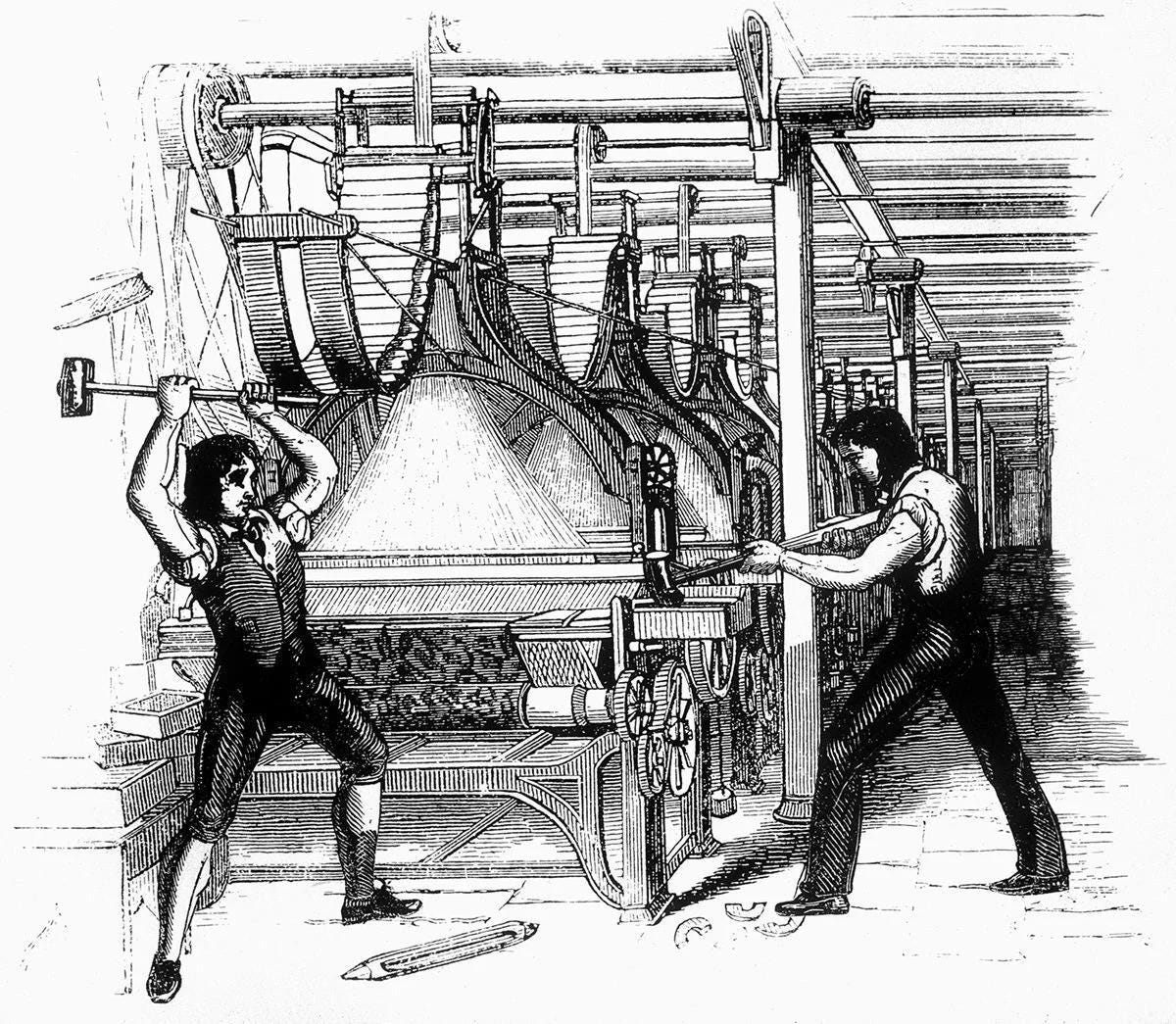
When I wrote of the fictional Lord Harcourt I was thinking of Mr. Secretary Ryder. In his parliamentary speech on February 14, 1812, Ryder was responding to the Nottinghamshire Luddite frame-breaking disturbances that had begun in late 1811. His stated motive was not sympathy for hunger or wage collapse, but the restoration of order and the protection of property. He says the disturbances were “lawless violence,” “enormities,” an “evil,” and “a system of riot” that had existed for three months and was “bordering almost on insurrection.”
The government’s first intelligence came on November 14, 1811, when the high sheriff asked for military assistance. Ryder says a squadron of dragoons was sent to Nottingham that day. By early December, officials feared the unrest would leech into Leicester and Derby, and between November 14 and December 9 the government sent 900 cavalry and 1,000 infantry into Nottingham, which Ryder himself calls an unusually large force for a local disturbance, and as I have stated in other places, the British public were naturally weary of militia presence in their part of town.2
Ryder also hints at an economic backstory for the Luddites. Trade had expanded about four years earlier because parts of South America were opened to British commerce; frames multiplied, hands were employed, and then, about two years later, the market failed. Manufacturers discharged workers, creating “discontent and distress,” worsened by the “unfavourable situation of trade.” But this admission is immediately contained: he says those “deplorable” circumstances still could not justify the frame-breakers. Frame-breaking was already a felony punishable by fourteen years’ transportation, but Ryder says that punishment had proved “completely insufficient.” His proposed remedy was to make it capital, in other words, punishable by death. He insists he is “by no means a friend to the increase of capital punishments,” and then, without irony, recommends one.
He justifies death through property and state danger. He points to the “immense body of property involved,” the “great expense” of machinery, nearly 1,000 frames broken, and the risk that continued destruction would become “dangerous to a state.” The Act that followed was blunt: offenders convicted of destroying or damaging stocking/lace frames or related machinery would “suffer Death” as felons “without Benefit of Clergy.
Why, it may be asked, should such a tremendous solution be fitted to so small a visible offense? A frame is broken and that is vandalism, but was it worth a life? The difficulty, in judging such a moment, lies in persuading the modern imagination to enter a mind so perpetually furnished with panic. To Mr. Ryder and those who supported him in Parliament, the broken frame was more than a broken frame. The Napoleonic Wars were causing paranoia and anxiety across Britain and the Luddites were considered by Ryder and his supporters as a domestic front in a country already at war. Additionally, if workers could destroy frames, meet in secret, threaten informers, and remain unawed by the militia, you had disobedience. And in a country at war with France, broken obedience was the one spectacle England could least afford to display.
For Further Study:
Feb 14 1812 Parliamentary Debates: https://api.parliament.uk/historic-hansard/commons/1812/feb/14/frame-breaking-and-nottingham-peace-bills
Feb 27 1812 Parliamentary Debates with a speech by Lord Byron: https://api.parliament.uk/historic-hansard/lords/1812/feb/27/frame-work-bill
The Frame Breaking Act 1812 in full: https://ludditebicentenary.blogspot.com/2012/03/20th-march-1812-1812-frame-breaking-act.html
Thomis, Malcolm I. The Luddites: Machine-Breaking in Regency England. Schocken Books, 1972.
Binfield, Kevin, editor. Writings of the Luddites. Johns Hopkins University Press, 2015. (I have some excerpts here I can share)
“So when all the land of Egypt was famished, the people cried to Pharaoh for bread. Then Pharaoh said to all the Egyptians, ‘Go to Joseph; whatever he says to you, do.’ The famine was over all the face of the earth, and Joseph opened all the storehouses and sold to the Egyptians […]” (Gen. 41.55–56)
"Evil was a convenient abstraction, while hunger had the disadvantage of belonging to the ghastly reality of individual stomachs." - beautifully written, your writing is truly captivating.
I feel that quote is the entire 1812 debate compressed into one sentence - and arguably the entire structure of any law that elects punishment over relief.
What I find most striking about the Ryder speech (and your reading of it) is that he names the wartime context openly. "Broken obedience was the one spectacle England could least afford to display." That's not law as justice, I see that law as performance for the audience across the Channel.
Do you think the death penalty in the 1812 Act was actually meant to be used or was it mostly a show of strength for France to see?
On a side note, is the pairing of fiction with archive something you're planning to continue? It works in a way I've not seen often, and reads really well!