
Thinking About the Other Side
Primary Sources from the Crimean War: Mary Seacole, Timothy Gowing, and Leo Tolstoy

Had he and I but met
By some old ancient inn,
We should have sat us down to wet
Right many a nipperkin!
But ranged as infantry,
And staring face to face,
I shot at him as he at me,
And killed him in his place.
I shot him dead because —
Because he was my foe,
Just so: my foe of course he was;
That’s clear enough; although
He thought he’d ‘list, perhaps,
Off-hand like — just as I —
Was out of work — had sold his traps —
No other reason why.
Yes; quaint and curious war is!
You shoot a fellow down
You’d treat if met where any bar is,
Or help to half-a-crown.1
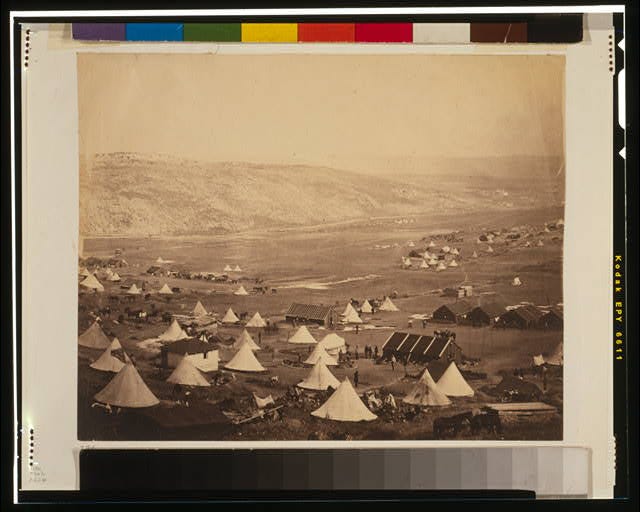
In war, it is easier, perhaps, to fire the gun or to release the shell, to press a button (or a series of buttons), when one imagines the faces of one’s own people. This, for my mother, my father, my children, my…my….my…..The droning on and on in a whole blurry procession of beloved figures that makes it all feel less like….violence. After all, isn’t it love, not hate, that has always been one of war’s most useful servants?2 But sometimes, more often than we admit, the imagination wanders across the line when the other side is allowed to be a mother too, a child too. What of them? Does the hand, hovering over the button, pause just a little in these instances?
For Mary Seacole, we see a glimpse of what it means to think more deeply about the other side. She traveled from Jamaica to the Crimea as a nurse of Creole descent, entering a warfront where suffering was abundant and help was desperately needed. In her writing, she documented her time in Balaclava, the main British supply port in Crimea. She says she remained there for six weeks, spending days ashore and nights on board ship, while sick and wounded men were carried down by mule trains and ambulances to be lifted into boats. Here is what she had to write about the misery she witnessed there and what it revealed about human nature:
“I have often heard men talk and preach very learnedly and conclusively about the great wickedness and selfishness of the human heart; I used to wonder whether they would have modified those opinions if they had been my companions for one day of the six weeks I spent upon that wharf, and seen but one day’s experience of the Christian sympathy and brotherly love shown by the strong to the weak. The task was a trying one, and familiarity, you might think, would have worn down their keener feelings of pity and sympathy; but it was not so.”3
She wrote of her experiences, examining the ordinary human heart under extreme duress. The ordinary human heart, in her view, did not necessarily become smaller or numb to misery’s consistent presence. It might, under such pressure, reveal some stubborn and inconvenient, but real tenderness. The first tenderness of war: the tenderness for one’s own.
In war, we are very accustomed to thinking of our own. Are we fighting for just and righteous reasons? Are our soldiers fed, clothed, tended to? Have our men suffered at all, but if they have, was it nobly? How many of ours have been lost, and how shall we count or honor them? These are very natural, human questions. Under the name of both grand ideals and logistics, they are not entirely wrong. Some may even call it loyalty “to the cause”, that finicky and dishonest phrase. After the Battle of the Tchernaya, fought on Aug 16 1855, when Russian forces made a major attack against the Allied position near the Chernaya River, Mrs. Seacole continues to help as much as she can:
“I attended another Russian, a handsome fellow, and an officer, shot in the side, who bore his cruel suffering with a firmness that was very noble. In return for the little use I was to him, he took a ring off his finger and gave it to me, and after I had helped to lift him into the ambulance he kissed my hand and smiled far more thanks than I had earned. I do not know whether he survived his wounds, but I fear not. Many others, on that day, gave me thanks in words the meaning of which was lost upon me, and all of them in that one common language of the whole world – smiles.”4
It is an altogether different task to find this tenderness for the “other side.” To think of the enemy as human requires a more exposed kind of vulnerability, because it seems, at first, to threaten the home front of feeling. If they also suffer from real and private agony, then what becomes of our own mourning? Does it become smaller? Does sympathy for them weaken the care we owe to our own?
The fear that humanity is a limited ration, and to spend any of it on the enemy is to rob the wounded at home, is a false one. But Seacole’s writing does not offer any easy fantasy in which everyone is equally innocent or absolved in any meaningful way. The Russian officer remains the enemy and, as always, war remains brutal (and we always rush to war knowing this fact). The British, French and Turkish wounded still remain in her charge.
In another scene, Sergeant Timothy Gowing, a British soldier of the 7th Royal Fusiliers, brings forward the less palatable aspect of the matter, where tenderness toward the “other side” gets contaminated and ugly. In his account of the Battle of the Alma, fought on Sep 20 1854, the first major battle after the Allied landing in Crimea, he describes a brutal uphill assault under heavy Russian artillery fire; the Fusiliers suffered badly, and the field afterward was filled with dead and wounded. The Russian wounded, in his telling, did not always lie before the British as injured men awaiting pity. They could make the generous soldier feel like a fool, and there are few injuries which men resent more bitterly than having been made fools by their own better impulses.
“The Russian wounded behaved in a most barbarous manner; they made signs for a drink, and then shot the man who gave it them. My attention was drawn to one nasty case. A young officer of the 95th gave a wounded Russian a little brandy out of his flask, and was turning to walk away, when the fellow shot him mortally; I would have settled with him for his brutish conduct, but one of our men, who happened to be close to him, at once gave him his bayonet, and despatched him. I went up to the young officer, and finding he was still alive, placed him in as comfortable a position as I could, and then left him, to look for my comrade.”5
It is impossible to know, from the distance at which we stand, whether the event occurred in precisely this manner, or whether one cruel moment, heated by fear and recollection, grew in Gowing’s mind into an indictment of “the Russian wounded” altogether. This uncertainty does not weaken the passage, since memory, after battle, is rarely a modest servant of fact, but this uncertainty is a distressed author of meaning, taking the unimaginable horrors, some confusion or fear and arranging them into forms the heart can bear to despise. “Barbarous,” “nasty,” “brutish” these are harsh words from a man who is still angry remembering all those years later.
But the more important point here is that the wounded Russian is no longer just some “wounded” enemy. He becomes a mirror held up to a British officer’s pity at the moment it is most vulnerable. Mercy is soft and therefore exposed; dangerously slow to defend itself. The shot that killed the young officer wounds the confidence that mercy and tenderness can be had in a place where every humane impulse may be mistaken for weakness. It lets the soldier say, with some relief and even some disgust, that pity for the other side was the error, not war. It is easy enough, or at least easier, to pity the enemy when he is handsome, grateful, noble in his suffering, and safely incapable of harming us. It is another thing entirely to think of his humanity after he has behaved badly, cruelly, treacherously.
Then comes cholera, that invisible sovereign of the camps. Gowing writes:
“There were all sorts of sports got up in the camp to keep up the men’s spirits, which was much needed; we had an unseen enemy in the midst of us—cholera—that was daily finding and carrying off its victims.”6
Disease killed more Allied soldiers than battle; of roughly 155,000 Allied dead, more than 95,000 are believed to have died from disease. In the British medical returns, cholera produced 7,574 hospital admissions and 4,512 deaths, a death rate of nearly sixty percent among those admitted7. It was only a fraction of total disease admissions, and yet it accounted for more than a quarter of disease deaths. The Russian enemy could be watched and pursued, but disease like Cholera gave its enemy no such satisfaction of a face to strike. Disease makes nonsense of the fine separations men construct. British, French, Turkish, Russian seized by the sudden terror of discovering that his own flesh, not another, has betrayed him. Against such an enemy, hatred has little power. You can pity, loathe, even find tenderness on the other side, but one cannot loathe cholera into feeling ashamed of itself or to act differently. Sometimes it’s you and the “other side” fighting against a third side.
This is where Leo Tolstoy’s depiction of the war is so beautiful, because he sees that both sides rest on the shared knowledge that they are surrounded by the same foe, that of death and disease and exhaustive all-encompassing suffering, even while they remain enemies. Nothing is forgiven and nothing is solved (and most importantly the dead remain dead) but in a little human exchange, thinking of the other side did matter. In one of those truces typical of siege warfare, where a pause allowed the dead and wounded to be gathered from the space between the Russian bastion and the French trenches at Sevastopol, he describes a scene:
“Then a bold [Russian] infantryman, in a pink shirt, with his cloak thrown over his shoulders, accompanied by two other soldiers, who, with their hands behind their backs, were standing behind him, with merry, curious countenances, stepped up to a Frenchman, and requested a light for his pipe. The Frenchman brightened his fire, stirred up his short pipe, and shook out a light for the Russian.”
___
“‘Tobacco good!’ said the soldier in the pink shirt; and the spectators smile.
‘Yes, good tobacco, Turkish tobacco,’ says the Frenchman. ‘And your tobacco—Russian?—good?’
‘Russian, good,’ says the soldier in the pink shirt: whereupon those present shake with laughter.”8
Tolstoy describes this weird juxtaposition between enemy and friend in this very ordinary, human exchange:
“Where is the expression of evil which should be avoided? Where is the expression of good which should be imitated in this sketch? Who is the villain, who the hero? All are good, and all are evil.”9
And then, with disappointing cruelty, the next day arrives and the men who laughed over traded tobacco, who recognized one another for one brief, ridiculous, luminous interval as creatures of appetite and manners and breath, return to their places and they become enemies again. The little human exchange remains evident that recognition is possible, and still insufficient. Maybe this is war’s cruelest basis: the other side can become human to us, fully and unmistakably, and still that recognition may save neither them nor us.
Hardy, Thomas. “The Man He Killed.” Time’s Laughingstocks and Other Verses, Macmillan, 1909
I love this poem so much I couldn’t help put it in full here. For another amazing poem from him, see The Darkling Thrush (https://www.poetryfoundation.org/poems/44325/the-darkling-thrush)
no, its definitely hate
Seacole, Mary. Wonderful Adventures of Mrs. Seacole in Many Lands. Edited by W. J. S., with an introductory preface by W. H. Russell, James Blackwood, 1857. A Celebration of Women Writers, University of Pennsylvania, digital.library.upenn.edu/women/seacole/adventures/adventures.html. Accessed 2 May 2026
see footnote 2
Gowing, Timothy. A Soldier’s Experience; or, A Voice from the Ranks: Showing the Cost of War in Blood and Treasure. Thomas Forman and Sons, 1896. Project Gutenberg, 2014, www.gutenberg.org/files/46989/46989-h/46989-h.htm . Accessed 29 Apr 2026
see footnote 4
I got into a little more detail on the affect of disease on the war here:

But for more interesting analyses and additional sources see the following (*ahem, let me know if you need access):
Hinton, Mike. “Daily Medical Care in the British Army during the Crimean War, 1854–56.” Topics in the History of Medicine, vol. 3, 2023, pp. 47–62. British Society for the History of Medicine, bshm.org.uk/wp-content/uploads/2024/01/thom-v3-47-62.pdf
Smallman-Raynor, Matthew, and Andrew D. Cliff. “The Geographical Spread of Cholera in the Crimean War: Epidemic Transmission in the Camp Systems of the British Army of the East, 1854–55.” Journal of Historical Geography, vol. 30, no. 1, Jan. 2004, pp. 32–69. ScienceDirect, https://doi.org/10.1016/S0305-7488(02)00084-1
Tolstoy, Leo. Sevastopol. Translated by Isabel F. Hapgood, Thomas Y. Crowell, 1888. Project Gutenberg, www.gutenberg.org/files/47197/47197-h/47197-h.htm. Accessed 17 Oct 2025
See footnote 7
This is some scholarly stuff. Joanna how in the world did you get into history on these topics. Impressive. Love the perspective from Tolstoy